

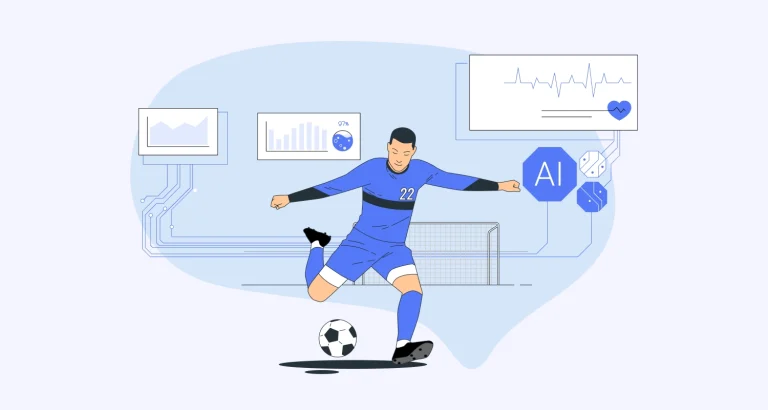
Since AI entered football, clubs have applied machine learning models, computer vision tools, and data analytics to pull clear facts from every match video. The global forecast for the AI in sports market predicts the market value will reach USD 4.7 billion by 2034. The aim of AI in football analysis extends beyond improved training drills; the system provides a proven edge over opponents.
What Is AI Film Analysis in Football?
At its core, AI Film Analysis in Football refers to using computer vision and machine learning in football analysis to analyze match footage automatically. Traditional analysts manually tag every pass, tackle, and goal. AI systems, on the other hand, identify and categorize thousands of micro-events in seconds. They can track player positioning, detect formation shifts, analyze ball possession stats, and predict how a play might unfold based on historical data.
Using football video analysis with AI, teams can recognize off-ball runs, tactical transitions, and weaknesses in the opponent’s strategy. The system studies the game like a human strategy coach would, but with improved accuracy and zero fatigue.
How AI Is Transforming Football Analysis
The integration of AI in football has evolved far beyond highlight generation. It is one of the strongest tools for performance reviews and strategy discussions at all levels of the game.
From Manual Tagging to Automated Insight
Manual analysis by pausing each game frame by frame was tiresome and often inaccurate. It also limited the amount of data that could be processed within a fixed duration. Modern AI models can automatically get deeper details about player movements, possession phases, and set-piece patterns. This allows analysis to focus solely on strategy and understanding the stats provided by AI, without worrying about the tedious process of manual data entry.
Unbiased and Consistent Evaluation
Human analysis is prone to bias on a subconscious level, even if the person is very objective in their analysis. Some players end up getting more attention, whereas others can be overlooked. AI-powered systems can be trained to provide objective evaluations, ensuring that all sprint, ball interceptions, and missed passes are recorded with the same standard of accuracy.
Pattern Recognition Beyond Human Limits
AI models detect various tactical trends across various games. They also reveal how a team’s full-backs behave when they switch from defense to attack. These AI-powered performance tracking systems add a new level of depth to tactical discussions.
Real-Time Data for In-Game Decisions
The future of sports intelligence is about acting in the moment. With real-time data, coaches can get information about player fatigue, formation weaknesses, and when to substitute players. It’s a precision strategy, brought to life on the field.
The Technology Behind AI Film Analysis
Computer Vision
High-definition cameras capture footage from multiple angles.
Algorithms detect players, the ball, and field zones using object detection.
Tracks each player’s movement in 3D space with high precision.
Deep Learning and Neural Networks
Models learn from thousands of hours of labeled footage.
Recognize complex patterns: overlapping runs, defensive compactness, attacking transitions.
Improve automatically over time for increasingly accurate insights.
Event Detection and Classification
Supervised learning classifies shots, passes, tackles, fouls, and other match events.
Structured tagging creates organized, easily reviewable data for coaches.
Predictive and Prescriptive Analytics
Predicts probabilities, e.g., the likelihood of scoring from certain positions.
Analyzes passing sequences with a better probability of scoring goals.
Teams are able to simulate and test strategies before executing them in the game.
Integration with Tracking and Wearable Data
Combines video insights with GPS and biometric information.
The report links sprint speed to visual fatigue indicators.
Helps prevent overtraining and reduces injury risk.
Real-World Applications of AI in Football
Tactical Optimization
Many popular clubs in the Premier League and La Liga use AI for studying opponents' pressing patterns and defensive loopholes. If data shows that a team leaves spaces in the wide areas during transitions, coaches can design plays to exploit such gaps.
Player Performance and Development
Youth academics and professional teams use AI in sports analytics to measure skills, efficiency, and decision-making speed. Players get AI-generated video clips that highlight both their strengths and areas for improvement, with practical suggestions and tips.
Injury Prevention and Load Management
Teams can also analyze player movement and fatigue data. This helps them identify when the player's physical output is dropping beyond safety levels. Doing so can help lower the chances of injuries and manage workloads more effectively.
Scouting and Recruitment
AI platforms can review thousands of match footage to identify players and match specific tactical profiles. This helps the scouting and recruitment teams scout faster, better, and at a much more cost-effective rate.
How AI Software Development Services Empower Football Clubs
Partnering with specialized AI software development services allows football clubs to design solutions that fit their goals, budgets, and existing systems. These AI-driven software solutions can track player performance, optimize tactics, and scouting processes. These AI software solutions can integrate smoothly with current systems, providing clubs with actionable insights. By using AI analysis capabilities, teams can make data-driven choices that enhance performance on and off the field.
The Future of Sports Intelligence Technology
The combination of AI in sports analytics and human expertise will continue to evolve rapidly. The coming years will bring even smarter and more interactive tools. Real-Time Coaching Assistants: In-game AI advisors providing tactical recommendations instantly. Augmented Reality Training: Players can receive visual feedback using AR glasses. Self-Learning Models: Systems adapt, update new tactics, and study match trends. Fan-Level Analytics: Mobile apps will offer fans predictive match insights and personalized stats.
Final Words
AI film analysis in football has opened up gates for modern sports intelligence technology to shine. Similar trends have also been seen in the NBA basketball league, which teamed up with AWS to provide AI-powered stats to basketball fans. If you want to use such AI in sports analytics features and capabilities, it is best to put your trust in a reliable AI software development company with proven experience in building such software solutions for the sports industry.