

Which Are the Least Appreciated Design Issues That Cause Machining Problems in Sports Parts?
The most technologically advanced sports equipment is not spared from machining issues caused by certain design flaws which may not be obvious on a CAD design. The following design flaws are some of the most costly issues that need to be avoided through DFM process.
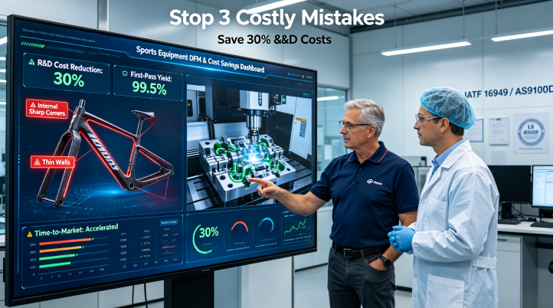
● The Expensive Problem of Internal Sharps Corners and Deep Cavities: Internal sharp corners, such as corners with a small radius (<1mm), require the use of small cutting tools that easily vibrate and break off. In particular, this problem is common in components with deep cavities such as bike derailleur mounts, because of increased tool deflection that results in poor finishing and dimensional accuracy of machined parts. Enlarging the internal radius of a component permits the use of bigger and stronger tools, resulting in reduced machining times and reduced tooling cost.
● Risks of Unstable and Unmanufacturable Thin Walls and Micro-Features: In the quest for lightweight designs, the tendency is to create parts with extremely thin walls (less than 0.8mm thick) or micro-features. As the part gets machined, the feature behaves similar to a drum, vibrating due to the cutting force. This leads to chatter marks, deformation, and even breakage. According to TWI Global standards on structural integrity, it is best to incorporate ribbing or increase the wall thickness to the minimum necessary, but at the manufacturable level.
● Failure to Provide Adequate Space for Tooling and Undercuts: Assembly components with complex geometries such as custom bike stem and helmet buckle often have concealed undercuts or hidden spaces where a regular tool cannot reach. Due to the lack of an early evaluation, the manufacturer will either be compelled to make custom tools (expensive process) or to divide the component into two pieces, causing longer assembly processes and potential failure points. Through toolpath simulation during the design process, these "dead zones" can be detected early on.
In What Ways Can The Application Of 5-Axis Milling Technology Create New Opportunities For Gear Design?
In cases where organic aerodynamics and continuity of surfaces are needed for sports equipment, three-axis machines fall short of what is needed to create such designs. It is only through five-axis CNC milling, which includes an additional two rotating axes, that the creation of new high-performance gears can be achieved.
1. From 3+2 Indexing to Full 5-Axis Milling Technology Although many factories do provide 3+2 axis machining services where the material piece is rotated to a set degree and machining done to it after fixing its position, full 5-axis machining capabilities are what are necessary for creating intricate surfaces. Such a surface would be that at the junction between head tubes of a bicycle frame.
2. True Single Setup Manufacturing for Critical Tolerances One of the main benefits of 5-axis technology is that it can manufacture nearly all features of an object in a single setup. This is especially helpful when producing something like a carbon fiber bike frame mold or a titanium crankarm because doing so would not produce cumulative error from multiple fixturing. The ability to create a truly representative model with tight tolerances for bearing press-fits and aerodynamic performance is crucial.
3. Hybrid Approach to Manufacturing: Combining Additive and Subtractive Technologies For ultra-lightweight designs featuring internal lattices, a pure subtractions process would be extremely time-consuming. Indeed, according to Additive Manufacturing sources, the future is hybrid technology. This means creating an object close to its desired dimensions via an additive process such as DMLS, then finishing it off through high-precision 5-axis milling. This method is rapidly transforming prosthetic design and elite cycling shoes.
What Is It About Micro-Milling That Makes It So Groundbreaking for Wearable Sports Tech?
As sports technologies become smaller and smarter, CNC machining alone isn't enough. Micro-milling uses cutting tools down to 0.1mm in diameter to enable a new generation of lightweight wearable technology for sports applications.
1. Pushing Back Against the Physical Limitations of Micro-Milling Micro-milling breaks the physical boundaries. The tooling for performing fine milling operations is fragile, and chips loads, needs to be monitored so that the work does not damage itself. The jobs like sensor bodies or micro gearings require speeds of 40,000 rpm and above, plus specialized cooling to carry the heat generated away from the cut.
2. The Importance of Surface Finish and Biocompatibility Fitness trackers and other wearable devices including smart eyewear demand both precise machining and extremely high-quality surface finish for their comfort to the users and precision in data collection. Micro-milling offers an opportunity for creating mirror-like finish on surfaces such as those made from PEEK and titanium, without requiring further treatment which might result in obstruction of small parts. In skin-contact products, this feature is crucial for ensuring biocompatibility. To learn more about precision CNC milling parts, check out this resources.
3. Providing for Integrated Electronics and Robust Housing Structures Micro-milling helps in machining precision cavities and pathways in order to mount the PCB and guide wires inside a compact housing space such as that available in a small watch housing or goggle housing. This allows for design integration, where multiple components are combined together to make one stronger component. Such precision in machining ensures the waterproof quality of these components and provides protection from any potential impacts.
How Is the Right Material Selection Critical to the Success of Precision Machining in Sports?
The choice of the correct material has a bearing on performance, cost-effectiveness, and ease of machining. Each of these advanced materials for use in sport equipment brings about their own challenges that have to be considered in order to prevent failure at an early stage.
1. Machining of Carbon Fiber Composites – A Precise and Challenging Task While being extremely strong, carbon fiber composite materials have one major drawback – they are extremely challenging to machine. Conventional cutting tools lose their sharpness very fast due to abrasiveness of carbon fiber, which causes delamination and fraying of edges. Successful machining of this material is possible only with diamond-coated tools, correct selection of parameters (high speed, low feed rate) and controlled dust formation. Incorrect machining can easily render a valuable carbon fiber bicycle useless.
2. High-Strength Alloys and Issues with Work Hardening The use of highly alloyed materials such as 7075 aluminum and 6Al-4V titanium in manufacturing of components of impact-resistance equipment, e.g. baseball bats and hockey sticks, makes machining of this type of parts challenging. High hardness and poor thermal conductivity of these materials lead to work hardening and thermal distortion that require specific machining parameters and cooling.
3. Emergence of Polymers for Engineering Applications and Their Challenges with Machining PEEK and UHMW polymeric materials have been gaining popularity due to their high resistance to friction and impacts. Though easier to machine than metals, these materials are challenging to machine due to their tendency to melt while machining and tolerance holding due to coefficient of thermal expansion. It is important to learn about material properties presented on the material datasheet, which can be consulted in books from sources like ASM International, to define the proper speeds and feeds.
What Is the Role of Quality Management Systems in Providing Consistency for Athletic Products? Consistency means trustworthiness for an athlete. Consistency is created by the Quality Management System within the manufacturing company. Certificates are not just pictures on the wall but a guarantee that each bicycle crank and helmet visor manufactured has identical performance parameters.
1. Traceability and Process Control: Goals of standards like ISO 9001 or IATF 16949 are minimum process documentation and traceability requirement which are key for sport brands. Every material, every tool change, and every inspection result needs to be documented. If there was a failure, it is easier to trace the root cause of it back to a specific process batch and will help providing quick response to help with brand image.
2. First-Article Inspection and Statistical Process Control: The robustness of a QMS is characterized by an in-depth First-Article Inspection (FAI) of each new part and any changes made to the processes in use. This includes checking all key dimensions in relation to the computer-aided design (CAD) model utilizing coordinate measuring machines (CMM) or scanning technology. In addition, SPC will track significant dimensions in real-time during production and detect if the product moves outside of acceptable tolerance.
3. Reduction of Risks through Supplier Qualification: Selecting a manufacturer that possesses AS9100D certification (aerospace) or IATF 16949 certification (automotive) represents an effective risk reduction solution. In accordance with these specifications, suppliers are expected to maintain a complex system of risk management and failure mode analysis. In case of a sports apparel company, it means that the supplier takes all necessary measures for avoiding risks on a production level.
Is Your Prototyping Process Fast Enough to Follow the Sports Innovation Cycle? Considering that sports products have a relatively short seasonality and athletes expect to see innovations regularly, an inefficient prototyping process can be a serious hindrance to success. Rapid prototyping through digital integration is crucial for the product innovation process.
1. The Strength of Digital Twinning and Virtual DFM The quickest prototype is the one that doesn’t require any physical revisions. With the use of CAD/CAM simulation and digital twin technology, designers can virtually perform the DFM analysis and correct machining errors, accessibility issues, and areas at risk of becoming weak spots without cutting any metal. “Getting it right the first time” saves both time and money.
2. Utilizing Rapid CNC Milling for Functional Prototypes While 3D printing is superb in producing an aesthetically perfect prototype, the rapid CNC milling technique allows you to make the real thing out of production-grade material. It means your prototype will be able to function as it should and be tested in a wind tunnel, a vibration rig, or even out in the field. Working with a partner who has fast machining services and flexible scheduling, your prototype can be produced in a matter of days.
3. From Prototypes to Production with Perfect Data Transition The best prototyping process is the one where the CAM programming and set-up sheets that go into making the prototype form the basis of mass production. The perfect transition of data makes sure that there is no need to undergo the "learning" curve again when the prototype moves to the stage of mass production. This is the final aim of an effective custom CNC milling services relationship.
Conclusion
Avoiding expensive mistakes in the production process of sports components is not about choosing an alternative supplier who charges less money. In the era of digital manufacturing, sports brands need to rely on DFM and utilize advanced techniques such as 5-axis machining and micro-milling, as well as find a reliable manufacturer whose quality management system will help ensure the success of both performance and cost reduction. In this way, the brand will use its investment in the development of the next-generation model efficiently and not let manufacturing obstacles undermine the result.
FAQs
Q1: How long does a typical CC/CFmold design and make take to produce a good, working model of the mold for a bike fork carbon fiber? A: For a more complex mold as this one requiring 5-axis machining, following steps of the mold production process (DFM, CAM program, machining and quality check) would normally cost 2-5 weeks
Q2: What state of tolerances can be reasonably obtained for mass production of metal sports equipment (e.g. aluminum bike cranks)? A: Advanced processes for manufacturing. 0.05mm to 0.025mm. Tighter tolerances are possible in this case but cost Quite a bit more and must be tightly statistically controlled..
Q3: What factors would a designer take into account when choosing between machining metal and machining high performance plastics like PEEK for the production of a wearable sports part? A: Mechanical stresses weight thermal conductivity and biological compatibility. Metals tend to have high tensile strengths whereas PEEK offers a high strength-to-weight ratio and excellent damping and chemical resistance. Consideration must be made of heat dissipation during machining of PEEK.
Q4: Can artificial ready-made parts be machined from the sheet materials made of Carbon Fiber Reinforced Plastic, and what are the problems? A: Yes it is possible, though not without some problems. For machining they will require diamond coated tools and optimum cutting conditions to minimize delamination and an adequate dust extraction system. Sometimes the edges needs to be sealed after machining.
Q5: What ensures that the performance of a prototype can predict the performance of the production part? A: Using the same grade of material, similar machining operations, and conducting identical inspections. The prototype manufacturing process specifications need to serve as the foundation of the production manufacturing process sheet.
Author Bio The conclusions that have been made in this article are based on the experience of the LS Manufacturing engineers. Being an authorized manufacturing company, they are focused on helping innovators deal with complicated engineering problems. Their professional CNC milling services cover all stages of development of a product, from prototyping of sports gear to its mass production. Feel free to contact them directly for a free DFM analysis of your component designs.