

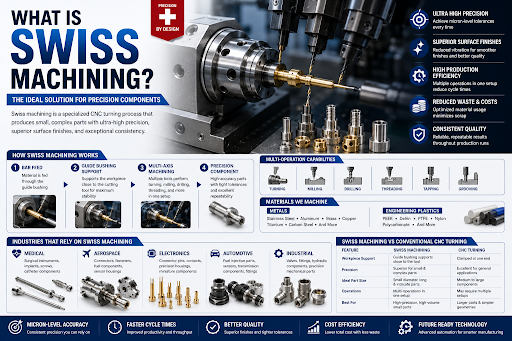
Originally developed for the Swiss watchmaking industry, Swiss machining has evolved into a highly advanced manufacturing process used across aerospace, medical, electronics, automotive, and industrial sectors. Its ability to maintain tight tolerances and produce intricate parts efficiently makes it a preferred choice for precision component manufacturing. In this article, we'll explore how Swiss machining works, its key advantages, and why it has become an essential technology for modern manufacturing.
What Is Swiss Machining?
Swiss machining is a specialized CNC turning process designed to manufacture small, complex, and highly precise components. Unlike conventional CNC lathes, Swiss machines use a sliding headstock that allows the workpiece to move through a guide bushing while machining operations are performed. This unique setup provides exceptional support for the material being machined, reducing vibration and deflection during cutting. As a result, manufacturers can achieve extremely tight tolerances and superior surface finishes. Many industries rely on swiss machining when producing precision components that require consistent quality and intricate geometries.
How Swiss Machining Works
Swiss machining differs significantly from traditional turning methods.
Guide Bushing Support System
The guide bushing is one of the most important features of a Swiss machine. It supports the material very close to the cutting tool, minimizing movement during machining and improving overall precision.
Sliding Headstock Technology
Instead of rotating a stationary workpiece, Swiss machines move the material through the guide bushing while cutting tools perform various operations. This design allows for greater accuracy, especially when machining long and slender parts.
Multi-Axis Machining Capabilities
Modern Swiss machines often include multiple axes and live tooling capabilities, enabling manufacturers to perform several operations in a single setup. These operations may include:
Turning
Milling
Drilling
Threading
Tapping
Grooving
Combining multiple processes into one setup reduces production time and improves consistency.
Key Advantages of Swiss Machining
Swiss machining offers several benefits that make it ideal for precision manufacturing.
Exceptional Precision
One of the biggest advantages of Swiss machining is its ability to achieve extremely tight tolerances. Manufacturers can consistently produce components with micron-level accuracy, making the process suitable for demanding applications.
Superior Surface Finishes
The guide bushing support system reduces vibration and tool chatter, resulting in smoother surface finishes and improved part quality.
Increased Production Efficiency
Because multiple operations can be completed in a single setup, Swiss machining reduces cycle times and increases manufacturing efficiency.
Reduced Material Waste
The process optimizes material usage and minimizes scrap, helping manufacturers improve cost efficiency.
Consistent Part Quality
Swiss machines provide repeatable precision, ensuring every component meets exact specifications throughout production runs.
Materials Commonly Used in Swiss Machining
Swiss machining supports a wide variety of materials.
Metals
Common metals include:
Stainless steel
Aluminum
Brass
Copper
Titanium
Carbon steel
Engineering Plastics
Manufacturers also machine high-performance plastics such as: PEEK Delrin PTFE Nylon
Polycarbonate
The ability to work with diverse materials makes Swiss machining suitable for numerous applications.
Industries That Rely on Swiss Machining
Many industries require the level of precision that Swiss machining provides.
Medical Device Manufacturing
Medical components often require extremely tight tolerances and flawless surface finishes. Applications include:
Surgical instruments
Bone screws
Orthopedic implants
Catheter components
Aerospace Industry
Aerospace manufacturers use Swiss machining for: Fasteners Connectors Fuel system components Sensor housings
Electronics Industry
Miniaturized electronic devices frequently contain Swiss-machined parts such as: Connectors Pins Contacts Precision housings
Automotive Industry
Automotive applications include: Fuel injection components Sensor parts Transmission components Precision fittings
Swiss Machining vs Conventional CNC Machining
Understanding the differences between these manufacturing methods helps businesses select the right process.
Precision
Swiss machining generally provides higher accuracy for small and complex parts.
Part Geometry
Long, slender components are easier to machine using Swiss technology because of the guide bushing support system.
Production Efficiency
Swiss machines can perform multiple operations simultaneously, reducing setup requirements and cycle times.
Cost Considerations
While machine setup costs may be higher, Swiss machining often becomes more cost-effective for high-volume precision production.
Challenges and Limitations of Swiss Machining
Although Swiss machining offers many advantages, it is not suitable for every application.
Higher Initial Setup Costs
Swiss machines are sophisticated pieces of equipment that require specialized tooling and programming.
Best for Small Components
The process is optimized for smaller parts and may not be the most economical solution for large components.
Skilled Programming Requirements
Achieving optimal results requires experienced CNC programmers and machine operators. Despite these challenges, the benefits often outweigh the limitations for precision manufacturing projects.
Future of Swiss Machining Technology
As manufacturing technology advances, Swiss machining continues to evolve. Emerging trends include:
AI-assisted machining optimization
Advanced automation systems
Real-time process monitoring
Smart manufacturing integration
Improved cutting tool technologies
These innovations are expected to further improve efficiency, precision, and production capabilities.
Conclusion
Swiss machining has become one of the most important technologies in modern precision manufacturing. Its unique guide bushing system, exceptional accuracy, and ability to perform multiple operations in a single setup make it ideal for producing small, complex components. From medical devices and aerospace systems to automotive and electronics applications, Swiss machining enables manufacturers to achieve the tight tolerances and consistent quality required in today's competitive industries. For companies seeking reliable, high-precision component production, Swiss machining remains one of the most effective manufacturing solutions available.
FAQs
What is Swiss machining?
Swiss machining is a specialized CNC machining process that uses a sliding headstock and guide bushing to produce highly precise small-diameter components.
Why is Swiss machining more accurate than traditional CNC turning?
The guide bushing supports the workpiece close to the cutting tool, reducing vibration and deflection while improving machining precision.
Which industries commonly use Swiss machining?
Industries such as medical devices, aerospace, automotive, electronics, and industrial manufacturing frequently use Swiss machining.
What materials can be used in Swiss machining?
Swiss machining can process materials including stainless steel, aluminum, brass, titanium, copper, PEEK, Delrin, and other engineering plastics.
Is Swiss machining suitable for high-volume production?
Yes. Swiss machining is highly efficient for medium- to high-volume production runs because it combines multiple machining operations into a single setup.